

Half A Pound Of Butter

Butter is a dairy production fabricated from the fat and protein components of churned cream. Information technology is a semi-solid emulsion at room temperature, consisting of approximately 80% butterfat. It is used at room temperature as a spread, melted equally a additive, and used as a fat in blistering, sauce-making, pan frying, and other cooking procedures.
Most oft made from moo-cow's milk, butter can likewise be manufactured from the milk of other mammals, including sheep, goats, buffalo, and yaks. It is made by churning milk or foam to separate the fatty globules from the buttermilk. Salt was added to butter from artifact to help to preserve it, particularly when being transported; salt may still play a preservation role simply is less important today every bit the entire supply chain is usually refrigerated. In modern times salt may be added for its gustation.[1] Food colorings are sometimes added to butter. Rendering butter, removing the water and milk solids, produces clarified butter or ghee, which is well-nigh entirely butterfat.
Butter is a water-in-oil emulsion resulting from an inversion of the cream, where the milk proteins are the emulsifiers. Butter remains a firm solid when refrigerated, merely softens to a spreadable consistency at room temperature, and melts to a thin liquid consistency at 32 to 35 °C (90 to 95 °F). The density of butter is 911 g/L (xv+ one⁄4 oz/US pt).[two] It mostly has a pale yellow color, but varies from deep xanthous to nearly white. Its natural, unmodified color is dependent on the source creature's feed and genetics, but the commercial manufacturing process sometimes manipulates the color with nutrient colorings similar annatto[3] or carotene.
Etymology
The word butter derives (via Germanic languages) from the Latin butyrum,[iv] which is the latinisation of the Greek βούτυρον (bouturon).[v] [6] This may be a compound of βοῦς (bous), "ox, cow"[7] + τυρός (turos), "cheese", that is "moo-cow-cheese".[8] [9] The discussion turos ("cheese") is attested in Mycenaean Greek.[10] The latinized form is plant in the name butyric acid, a compound found in rancid butter[11] and dairy products such as Parmesan cheese.[12]
Production

Churning foam into butter using a hand-held mixer.
Unhomogenized milk and cream contain butterfat in microscopic globules. These globules are surrounded past membranes made of phospholipids (fat acid emulsifiers) and proteins, which forbid the fat in milk from pooling together into a single mass. Butter is produced by agitating cream, which amercement these membranes and allows the milk fats to conjoin, separating from the other parts of the cream. Variations in the production method volition create butters with different consistencies, mostly due to the butterfat composition in the finished product. Butter contains fatty in three separate forms: free butterfat, butterfat crystals, and undamaged fatty globules. In the finished product, dissimilar proportions of these forms result in different consistencies within the butter; butters with many crystals are harder than butters dominated by free fats.[ citation needed ]
Churning produces small butter grains floating in the water-based portion of the foam. This watery liquid is chosen buttermilk—although the buttermilk most mutual today is instead a straight fermented skimmed milk.[thirteen] The buttermilk is drained off; sometimes more buttermilk is removed by rinsing the grains with h2o. Then the grains are "worked": pressed and kneaded together. When prepared manually, this is done using wooden boards called scotch easily. This consolidates the butter into a solid mass and breaks upward embedded pockets of buttermilk or water into tiny aerosol.[ citation needed ]
Commercial butter is about 80% butterfat and 15% water; traditionally made butter may accept equally little every bit 65% fat and xxx% water. Butterfat is a mixture of triglyceride, a triester derived from glycerol and iii of any of several fatty acid groups.[14]
Types

Chart of milk products and production relationships, including butter.
Before modern factory butter making, cream was usually collected from several milkings and was therefore several days old and somewhat fermented by the time it was made into butter. Butter fabricated from a fermented cream is known as cultured butter. During fermentation, the cream naturally sours as bacteria convert milk sugars into lactic acid. The fermentation process produces additional aroma compounds, including diacetyl, which makes for a fuller-flavored and more "buttery" tasting product.[fifteen] : 35
Dairy products are frequently pasteurized during product to kill pathogenic bacteria and other microbes. Butter made from pasteurized fresh cream is called sweet cream butter. Product of sweet cream butter commencement became common in the 19th century, with the development of refrigeration and the mechanical cream separator.[15] : 33
Cultured butter is preferred throughout continental Europe, while sweet cream butter dominates in the United States and the United Kingdom. Cultured butter is sometimes labeled "European-style" butter in the United States, although cultured butter is made and sold past some, especially Amish, dairies. Commercial raw cream butter is virtually unheard of in the United States. Raw cream butter is generally just found made at home by consumers who accept purchased raw whole milk directly from dairy farmers, skimmed the cream themselves, and made butter with information technology. It is rare in Europe likewise.[15] : 34
Clarified butter

Clarified butter has almost all of its water and milk solids removed, leaving almost-pure butterfat. Antiseptic butter is fabricated by heating butter to its melting point and and then assuasive it to cool; after settling, the remaining components separate past density. At the top, whey proteins form a skin, which is removed. The resulting butterfat is then poured off from the mixture of water and casein proteins that settle to the lesser.[fifteen] : 37
Ghee is clarified butter that has been heated to around 120 °C (250 °F) later on the water evaporated, turning the milk solids brown. This process flavors the ghee, and likewise produces antioxidants that aid protect it from rancidity. Because of this, ghee tin be kept for six to eight months under normal conditions.[15] : 37
Whey butter
Foam may exist separated (usually by a centrifuge or a sedimentation) from whey instead of milk, as a byproduct of cheese-making. Whey butter may be made from whey cream. Whey cream and butter accept a lower fat content and taste more salty, tangy and "cheesy".[sixteen] They are besides cheaper to make than "sweet" cream and butter. The fat content of whey is low, so thousand pounds of whey will typically requite 3 pounds of butter.[17] [18]
European butters
In that location are several butters produced in Europe with protected geographical indications; these include:
- Beurre d'Ardenne, from Belgium
- Beurre d'Isigny, from France
- Beurre Charentes-Poitou (Which also includes: Beurre des Charentes and Beurre des Deux-Sèvres under the same classification), from France
- Beurre Rose, from Luxembourg
- Mantequilla de Soria, from Spain
- Mantega de l'Alt Urgell i la Cerdanya, from Spain
- Rucava white butter (Rucavas baltais sviests), from Latvia[nineteen]
History

Traditional butter-making in Palestine. Ancient techniques were still practiced in the early 20th century. National Geographic, March 1914.
According to Harold McGee the earliest milk production would take been from sheep or caprine animal's milk in the expanse of Iran and Iraq around 9,000 to 8,000 BCE and butter would take soon been found naturally in milk containers; cattle are not idea to have been domesticated for another thousand years.[20] A later Sumerian tablet, dating to approximately 2,500 BCE, describes the butter making procedure, from the milking of cattle,[21] [22] while contemporary Sumerian tablets identify butter equally a ritual offering.[23]
In the Mediterranean climate, unclarified butter spoils apace, unlike cheese, and then it is not a practical method of preserving the nutrients of milk. The ancient Greeks and Romans seemed to accept considered butter a food fit more for the northern barbarians. A play by the Greek comic poet Anaxandrides refers to Thracians as boutyrophagoi, "butter-eaters".[24] In his Natural History, Pliny the Elderberry calls butter "the most delicate of food among barbarous nations" and goes on to depict its medicinal backdrop.[25] Later, the physician Galen also described butter equally a medicinal agent only.[26]
Middle Ages

Woman churning butter; Compost et Kalendrier des Bergères, Paris 1499
In the libation climates of northern Europe, people could shop butter longer before it spoiled. Scandinavia has the oldest tradition in Europe of butter export trade, dating at least to the twelfth century.[27] Afterwards the fall of Rome and through much of the Centre Ages, butter was a common food across virtually of Europe—just had a low reputation, and then was consumed principally by peasants. Butter slowly became more accustomed by the upper form, notably when the early 16th century Roman Catholic Church building allowed its consumption during Lent. Staff of life and butter became mutual fare among the eye class and the English, in detail, gained a reputation for their liberal apply of melted butter as a sauce with meat and vegetables.[15] : 33
In antiquity, butter was used for fuel in lamps, as a substitute for oil. The Butter Belfry of Rouen Cathedral was erected in the early 16th century when Archbishop Georges d'Amboise authorized the burning of butter during Lent, instead of oil, which was scarce at the time.[28]
Across northern Europe, butter was sometimes treated in a way unheard-of today: it was packed into barrels (firkins) and cached in peat bogs, perhaps for years. Such "bog butter" would develop a strong season as it aged, but remain edible, in large part considering of the unique cool, airless, antiseptic and acidic environment of a peat bog. Firkins of such buried butter are a mutual archaeological detect in Ireland; the National Museum of Ireland – Archæology has some containing "a grayish cheese-similar substance, partially hardened, non much like butter, and quite costless from putrefaction." The do was most mutual in Republic of ireland in the 11th–14th centuries; it ended entirely earlier the 19th century.[27]
Industrialization
Like Ireland, France became well known for its butter, peculiarly in Normandy and Brittany. Butter consumption in London in the mid 1840s was estimated at 15,357 tons annually.[29]

Gustaf de Laval'due south centrifugal cream separator sped upwardly the butter-making process.
Until the 19th century, the vast majority of butter was made by mitt, on farms. The first butter factories appeared in the United States in the early on 1860s, after the successful introduction of cheese factories a decade before. In the late 1870s, the centrifugal foam separator was introduced, marketed most successfully by Swedish engineer Carl Gustaf Patrik de Laval.[30]
In 1920, Otto Hunziker authored The Butter Industry, Prepared for Factory, Schoolhouse and Laboratory,[31] a well-known text in the industry that enjoyed at least 3 editions (1920, 1927, 1940). As office of the efforts of the American Dairy Science Association, Professor Hunziker and others published articles regarding: causes of tallowiness[32] (an odor defect, distinct from rancidity, a taste defect); mottles[33] (an artful event related to uneven colour); introduced salts;[34] the impact of creamery metals[35] and liquids;[36] and acidity measurement.[37] These and other ADSA publications helped standardize practices internationally.
Butter too provided extra income to farm families. They used wood presses with carved decoration to press butter into pucks or minor bricks to sell at nearby markets or general stores. The decoration identified the farm that produced the butter. This practice continued until production was mechanized and butter was produced in less decorative stick form.[38]
Butter consumption declined in most western nations during the 20th century, mainly because of the ascent popularity of margarine, which is less expensive and, until recent years, was perceived as being healthier. In the United States, margarine consumption overtook butter during the 1950s,[39] and it is withal the case today that more margarine than butter is eaten in the U.S. and the EU.[40]
Worldwide production
| Country | Product 2018 (tonnes) | |||
|---|---|---|---|---|
| 1 |  United states of america United states of america | 892,801 | ||
| 2 |  New Zealand New Zealand | 502,000 | ||
| 3 |  Frg Frg | 484,047 | ||
| 4 |  France France | 352,400 | ||
| v |  Russia Russia | 257,883 | ||
| six |  Republic of ireland Republic of ireland | 237,800 | ||
| 7 |  Turkey Turkey | 215,431 | ||
| 8 |  Iran Iran | 183,125 | ||
| ix |  Poland Poland | 177,260 | ||
| x |  United mexican states United mexican states | 153,674 | ||
| 11 |  United Kingdom United Kingdom | 152,000 | ||
| 12 |  Canada Canada | 116,144 | ||
| thirteen |  Belarus Belarus | 115,199 | ||
| fourteen |  Brazil Brazil | 109,100 | ||
| fifteen |  Ukraine Ukraine | 100,000 | ||
| Source : FAOSTAT | ||||
In 1997, India produced i,470,000 metric tons (i,620,000 curt tons) of butter, most of which was consumed domestically.[41] Second in production was the United states of america (522,000 t or 575,000 short tons), followed by France (466,000 t or 514,000 short tons), Germany (442,000 t or 487,000 brusque tons), and New Zealand (307,000 t or 338,000 short tons). France ranks kickoff in per capita butter consumption with 8 kg per capita per year.[42] In terms of absolute consumption, Germany was second subsequently Republic of india, using 578,000 metric tons (637,000 short tons) of butter in 1997, followed past France (528,000 t or 582,000 short tons), Russia (514,000 t or 567,000 short tons), and the Us (505,000 t or 557,000 brusk tons). New Zealand, Australia, and Ukraine are among the few nations that export a significant percent of the butter they produce.[43]
Different varieties are constitute effectually the world. Smen is a spiced Moroccan antiseptic butter, cached in the ground and aged for months or years. A similar product is maltash of the Hunza Valley, where cow and yak butter tin be buried for decades, and is used at events such as weddings.[44] Yak butter is a specialty in Tibet; tsampa, barley flour mixed with yak butter, is a staple food. Butter tea is consumed in the Himalayan regions of Tibet, Bhutan, Nepal and India. It consists of tea served with intensely flavored—or "rancid"—yak butter and salt. In African and Asian developing nations, butter is traditionally made from sour milk rather than cream. It tin can accept several hours of churning to produce workable butter grains from fermented milk.[45]
Storage
Normal butter softens to a spreadable consistency around 15 °C (60 °F), well above refrigerator temperatures. The "butter compartment" establish in many refrigerators may be 1 of the warmer sections inside, but it still leaves butter quite difficult. Until recently, many refrigerators sold in New Zealand featured a "butter conditioner", a compartment kept warmer than the balance of the refrigerator—but still cooler than room temperature—with a pocket-sized heater.[46] Keeping butter tightly wrapped delays rancidity, which is hastened by exposure to low-cal or air, and also helps prevent it from picking up other odors. Wrapped butter has a shelf life of several months at refrigerator temperatures.[47] Butter tin can as well be frozen to further extend its storage life.[48]
Packaging
Us
In the United States, butter has traditionally been made into small, rectangular blocks by means of a pair of wooden butter paddles. It is unremarkably produced in 4-ounce ( ane⁄4 lb; 110 1000) sticks that are individually wrapped in waxed or foiled paper, and sold as a one pound (0.45 kg) package of 4 sticks. This practise is believed to have originated in 1907, when Swift and Company began packaging butter in this manner for mass distribution.[49]

Western-pack shape unsalted butter

Eastern-pack shape salted butter
Due to historical differences in butter printers (machines that cutting and package butter),[50] four-ounce sticks are unremarkably produced in 2 dissimilar shapes:
- The dominant shape east of the Rocky Mountains is the Elgin, or Eastern-pack shape, named for a dairy in Elgin, Illinois. The sticks measure out 4+ 3⁄4 by 1+ 1⁄4 by 1+ 1⁄4 inches (121 mm × 32 mm × 32 mm) and are typically sold stacked 2 by two in elongated cube-shaped boxes.[50]
- West of the Rocky Mountains, butter printers standardized on a dissimilar shape that is now referred to every bit the Western-pack shape. These butter sticks measure out 3+ one⁄4 past 1+ ane⁄2 by i+ 1⁄2 inches (83 mm × 38 mm × 38 mm)[51] and are normally sold with four sticks packed side-by-side in a apartment, rectangular box.[fifty]
Most butter dishes are designed for Elgin-mode butter sticks.[l]
Elsewhere
Exterior of the Us, butter is measured for sale by mass (rather than by book or unit/stick), and is sold in 250 g (8.eight oz) and 500 yard (18 oz) packages.
Bulk packaging
Since the 1940s,[52] but more normally the 1960s,[53] butter pats accept been individually wrapped and packed in cardboard boxes. Prior to use of cardboard, butter was bulk packed in woods. The earliest discoveries used firkins. From about 1882 wooden boxes were used, as the introduction of refrigeration on ships brought about longer transit times. Butter boxes were generally fabricated with woods whose resin would not taint the butter,[52] such as sycamore,[53] kahikatea,[54] hoop pine,[55] maple, or spruce.[52] They commonly weighed a firkin - 56 pounds (25 kg).[52]
In cooking and gastronomy
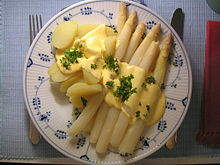
Butter has been considered indispensable in French cuisine since the 17th century.[56] Chefs and cooks accept extolled its importance: Fernand Bespeak said "Donnez-moi du beurre, encore du beurre, toujours du beurre!" ('Give me butter, more butter, yet more butter!');[57] Julia Child said "With enough butter, annihilation is good."[58]
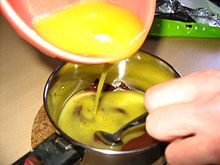
Mixing melted butter with chocolate to make a brownie.
Melted butter plays an important role in the preparation of sauces, notably in French cuisine. Beurre noisette (hazelnut butter) and Beurre noir (black butter) are sauces of melted butter cooked until the milk solids and sugars have turned golden or dark brown; they are often finished with an improver of vinegar or lemon juice.[15] : 36 Hollandaise and béarnaise sauces are emulsions of egg yolk and melted butter. Hollandaise and béarnaise sauces are stabilized with the powerful emulsifiers in the egg yolks, but butter itself contains enough emulsifiers—more often than not remnants of the fat globule membranes—to form a stable emulsion on its own.[15] : 635–636
Beurre blanc (white butter) is fabricated by whisking butter into reduced vinegar or vino, forming an emulsion with the texture of thick cream. Beurre monté (prepared butter) is melted but notwithstanding emulsified butter; information technology lends its proper noun to the practice of "mounting" a sauce with butter: whisking cold butter into any water-based sauce at the finish of cooking, giving the sauce a thicker body and a glossy shine—as well as a buttery taste.[15] : 632
Butter is used for sautéing and frying, although its milk solids brown and burn higher up 150 °C (250 °F)—a rather low temperature for nearly applications. The smoke bespeak of butterfat is around 200 °C (400 °F), so antiseptic butter or ghee is better suited to frying.[fifteen] : 37
Butter fills several roles in baking, where it is used in a similar manner as other solid fats like lard, suet, or shortening, only has a flavor that may ameliorate complement sweetness baked goods.
Nutritional data
Equally butter is substantially just the milk fat, it contains only traces of lactose, and so moderate consumption of butter is not a trouble for lactose intolerant people.[59] People with milk allergies may withal demand to avoid butter, which contains enough of the allergy-causing proteins to cause reactions.[60] Whole milk, butter and cream have high levels of saturated fat.[61] [62]
| Nutritional value per 1 The states Tbsp (14.2g) | |
|---|---|
| Energy | 101.eight kcal (426 kJ) |
| Carbohydrates | 0.01 g |
| Sugars | 0.01 g |
| Fat | 11.5 m |
| Saturated | seven.3 chiliad |
| Trans | 0.5 one thousand |
| Monounsaturated | iii g |
| Polyunsaturated | 0.iv one thousand |
| Poly peptide | 0.1 chiliad |
| Vitamins | Quantity %DV † |
| Vitamin A equiv. | 12% 97.1 μg |
| Vitamin A | 355 IU |
| Vitamin B12 | one% 0.024 μg |
| Vitamin E | 2% 0.33 mg |
| Vitamin K | one% 0.99 μg |
| Other constituents | Quantity |
| Cholesterol | 30.5 mg |
| USDA 01145, Butter, without table salt. | |
| |
| †Percentages are roughly approximated using United states recommendations for adults. Source: USDA FoodData Central | |
| Type of fat | Full fat (g) | Saturated fat (grand) | Monounsaturated fatty (g) | Polyunsaturated fatty (g) | Smoke point |
|---|---|---|---|---|---|
| Butter[63] | 80-88 | 43-48 | fifteen-19 | 2-3 | 150 °C (302 °F)[64] |
| Canola oil[65] | 100 | vi-vii | 62-64 | 24-26 | 205 °C (401 °F)[66] [67] |
| Coconut oil[68] | 99 | 83 | half-dozen | 2 | 177 °C (351 °F) |
| Corn oil[69] | 100 | thirteen-14 | 27-29 | 52-54 | 230 °C (446 °F)[64] |
| Lard[70] | 100 | 39 | 45 | xi | 190 °C (374 °F)[64] |
| Peanut oil[71] | 100 | 17 | 46 | 32 | 225 °C (437 °F)[64] |
| Olive oil[72] | 100 | 13-19 | 59-74 | 6-sixteen | 190 °C (374 °F)[64] |
| Rice bran oil | 100 | 25 | 38 | 37 | 250 °C (482 °F)[73] |
| Soybean oil[74] | 100 | 15 | 22 | 57-58 | 257 °C (495 °F)[64] |
| Suet[75] | 94 | 52 | 32 | 3 | 200 °C (392 °F) |
| Ghee[76] | 99 | 62 | 29 | 4 | 204 °C (399 °F) |
| Sunflower oil[77] | 100 | ten | 20 | 66 | 225 °C (437 °F)[64] |
| Sunflower oil (high oleic) | 100 | 12 | 84[66] | 4[66] | |
| Vegetable shortening [78] | 100 | 25 | 41 | 28 | 165 °C (329 °F)[64] |
Health concerns
A 2015 study concluded that "hypercholesterolemic people should go along their consumption of butter to a minimum, whereas moderate butter intake may exist considered part of the diet in the normocholesterolemic population."[79]
A meta-analysis and systematic review published in 2016 establish relatively small or insignificant overall associations of a dose of 14g/day of butter with mortality and CVD, and consumption was inversely associated with incidence of diabetes. The report further states that "findings do not support a demand for major accent in dietary guidelines on either increasing or decreasing butter consumption."[80] [81]
Meet also
- List of butter dishes
- Listing of dairy products
- Listing of butter sauces
- List of spreads
References
- ^ Institute of Medicine. Committee on Strategies to Reduce Sodium Intake; Henney, Jane E.; Taylor, Christine Lewis; Boon, Caitlin S. (2010). "4: Preservation and Physical Property Roles of Sodium in Foods". Strategies to reduce sodium intake in the United States. National Academies Press. Washington, D.C. ISBN978-0-309-14805-four. OCLC 676698420.
- ^ Elert, Glenn. "Density". The Physics Hypertextbook. Archived from the original on 19 August 2018. Retrieved 26 March 2018.
- ^ Saïd, Husein; Nada, I. A. A. (1946). "A Substitute for 'Annatto' in Butter". Nature. 157 (3982): 232. Bibcode:1946Natur.157..232S. doi:10.1038/157232a0. PMID 21017927. S2CID 4131974. Retrieved two November 2018.
- ^ butyrum Archived 27 Jan 2012 at the Wayback Machine, Charlton T. Lewis, Charles Brusk, A Latin Dictionary, on Perseus
- ^ βούτυρον Archived 17 March 2012 at the Wayback Machine, Henry George Liddell, Robert Scott, A Greek-English Dictionary, on Perseus
- ^ butter Archived 14 Nov 2010 at the Wayback Machine, Oxford Dictionaries
- ^ βοῦς Archived 17 March 2012 at the Wayback Auto, Henry George Liddell, Robert Scott, A Greek-English Lexicon, on Perseus
- ^ τυρός Archived 16 March 2012 at the Wayback Auto, Henry George Liddell, Robert Scott, A Greek-English Lexicon, on Perseus
- ^ Beekes, Robert Stephen Paul, and Lucien Van Beek. Etymological dictionary of Greek. Vol. 2. Leiden: Brill, 2014
- ^ Palaeolexicon Archived 4 March 2012 at the Wayback Car, Word study tool of ancient languages
- ^ Widder, Sabine; Sen, Alina; Grosch, Werner (1 July 1991). "Changes in the season of butter oil during storage". Zeitschrift für Lebensmittel-Untersuchung und Forschung. 193 (1): 32–35. doi:x.1007/BF01192013. ISSN 1438-2385. S2CID 82639499.
- ^ Perko, B.; Habjan-Penca, V.; Godic, M. (1988). "Biochemical parameters of retarded fermentation of Parmesan cheese". Agris. Food and Agronomical Arrangement of the United nations.
- ^ Morin, P.; Pouliot, Y.; Jiménez-Flores, R. (1 December 2006). "A comparative study of the fractionation of regular buttermilk and whey buttermilk by microfiltration". Periodical of Food Engineering. 77 (3): 521–528. doi:10.1016/j.jfoodeng.2005.06.065. ISSN 0260-8774.
- ^ Rolf Jost "Milk and Dairy Products" Ullmann's Encyclopedia of Industrial Chemistry, Wiley-VCH, Weinheim, 2002. doi:10.1002/14356007.a16_589.pub3
- ^ a b c d e f yard h i j McGee, Harold (2004). On Food and Cooking: The Science and Lore of the Kitchen. New York City: Scribner. ISBN978-0-684-80001-1. LCCN 2004058999. OCLC 56590708.
- ^ "Article on sweet foam, whey cream, and the butters they produce". Kosher. Archived from the original on 20 Feb 2012. Retrieved 24 October 2014.
- ^ Charles Thom, Walter Fisk, The Volume of Cheese, 1918, reprinted in 2007 equally ISBN 1429010746, p. 296
- ^ Doane, Charles Francis (12 Nov 2017). "Whey butter". Washington, D.C. : U.Due south. Dept. of Agriculture, Bureau of Animal Industry. Archived from the original on 28 May 2017. Retrieved 29 Dec 2017 – via Internet Archive.
- ^ "No buts, it's Rucava butter!". Public Broadcasting of Republic of latvia. LETA. six September 2018. Retrieved 11 September 2018.
- ^ Dates from McGee p. x.
- ^ McCormick, Finbar (1 December 2012). "Cows, milk and religion: the use of dairy produce in early on societies". Anthropozoologica. 47 (2): 101–113. doi:10.5252/az2012n2a7. ISSN 0761-3032. S2CID 55564559.
- ^ Churncraft. "A Brief History of Butter". Churncraft . Retrieved eleven September 2022.
- ^ Unknown. Cuneiform tablet: offering of butter for the god Suen.
- ^ Dalby p. 65.
- ^ Bostock and Riley translation. Book 28, affiliate 35.
- ^ Galen. de aliment. facult.
- ^ a b Web Exhibits: Butter. Ancient Firkins Archived 21 October 2005 at the Wayback Machine.
- ^ Soyer, Alexis (1977) [1853]. The Pantropheon or a History of Food and its Preparation in Ancient Times. Wisbech, Cambs.: Paddington Printing. p. 172. ISBN978-0-448-22976-8.
- ^ The National Cyclopaedia of Useful Cognition, Vol.III, London (1847) Charles Knight, p.975.
- ^ Edwards, Everett E. "Europe'southward Contribution to the American Dairy Industry". The Journal of Economic History, Volume 9, 1949. 72-84.
- ^ Hunziker, O F (1920). The Butter Industry, Prepared for Factory, Schoolhouse and Laboratory. LaGrange, IL: author.
- ^ Hunziker, O F; D. Fay Hosman (1 November 1917). "Tallowy Butter—its Causes and Prevention". Journal of Dairy Science. American Dairy Science Association. 1 (4): 320–346. doi:ten.3168/jds.S0022-0302(17)94386-three.
- ^ Hunziker, O F; D. Fay Hosman (one March 1920). "Mottles in Butter—Their Causes and Prevention". Journal of Dairy Science. American Dairy Science Clan. 3 (2): 77–106. doi:x.3168/jds.S0022-0302(20)94253-four.
- ^ Hunziker, O F; W. A. Cordes; B. H. Nissen (i September 1929). "Studies on Butter Salts". Periodical of Dairy Science. American Dairy Scientific discipline Association. 11 (5): 333–351. doi:10.3168/jds.S0022-0302(28)93647-4.
- ^ Hunziker, O F; Westward. A. Cordes; B. H. Nissen (one March 1929). "Metals in Dairy Equipment. Metallic Corrosion in Milk Products and its Consequence on Flavor". Journal of Dairy Science. American Dairy Science Association. 12 (2): 140–181. doi:10.3168/jds.S0022-0302(29)93566-9.
- ^ Hunziker, O F; W. A. Cordes; B. H. Nissen (ane May 1929). "Metals in Dairy Equipment: Corrosion Acquired past Washing Powders, Chemical Sterilizers, and Refrigerating Brines". Journal of Dairy Science. American Dairy Science Association. 12 (3): 252–284. doi:10.3168/jds.S0022-0302(29)93575-X.
- ^ Hunziker, O F; Westward. A. Cordes; B. H. Nissen (ane July 1931). "Method for Hydrogen Ion Determination of Butter". Journal of Dairy Science. American Dairy Science Association. fourteen (iv): 347–37. doi:10.3168/jds.S0022-0302(31)93478-4.
- ^ Hale, Sarah Josepha Buell (1857). Mrs. Hale's new cook volume.
- ^ Web Exhibits: Butter. Eating less butter, and more fat Archived 14 December 2005 at the Wayback Machine.
- ^ Run across for example this chart Archived 8 September 2005 at the Wayback Auto from International Margarine Clan of the Countries of Europe statistics Archived 30 September 2005 at the Wayback Machine. Retrieved 4 December 2005.
- ^ Most nations produce and consume the bulk of their butter domestically.
- ^ "Envoyé spécial". francetv info. Archived from the original on xviii December 2010. Retrieved 24 Oct 2014.
- ^ Statistics from USDA Foreign Agricultural Service (1999). Dairy: Give-and-take Markets and Trade Archived 23 September 2005 at the Wayback Automobile. Retrieved 1 December 2005. The export and import figures practice non include trade between nations within the European Spousal relationship, and there are inconsistencies regarding the inclusion of clarified butterfat products (explaining why New Zealand is shown exporting more butter in 1997 than was produced).
- ^ Salopek, Paul (23 January 2018). "Here, the Homemade Butter Is Aged for Half a Century". National Geographic Society. Archived from the original on 24 January 2018.
- ^ Crawford et al., function B, department III, ch. one: Butter Archived 3 Feb 2006 at the Wayback Machine. Retrieved 28 November 2005.
- ^ Bring back butter conditioners Archived 27 September 2007 at the Wayback Car. Retrieved 27 November 2005. The characteristic has been phased out for free energy conservation reasons.
- ^ How Long Does Butter Concluding? Archived 6 October 2014 at the Wayback Auto. Retrieved 03, October 2014.
- ^ Webb, Byron H.; Arbuckle, Wendell S. (1977), Desrosier, Norman W.; Tressler, Donald K. (eds.), "Freezing of Dairy Products", Fundamentals of Food Freezing, Dordrecht: Springer Netherlands, pp. 357–395, doi:x.1007/978-94-011-7726-9_9, ISBN978-94-011-7726-9 , retrieved 26 May 2021
- ^ Parker, Milton Eastward. (1948). "Princely Packets of Golden Health (A History of Butter Packaging)" (PDF). Archived from the original (PDF) on 6 October 2006. Retrieved fifteen Oct 2006.
- ^ a b c d "A Amend Stick of Butter?". Cook's Illustrated (77): 3. November–December 2005.
- ^ "Commercial Butter Making and Packaging Machines". Schier Company, Inc. Archived from the original on 20 May 2018. Retrieved nineteen May 2018.
- ^ a b c d Milton Due east. Parker (1948). "A History of Butter Packaging" (PDF). Archived (PDF) from the original on 19 December 2003.
- ^ a b "Butter crate | SA/PKC/PRO/1/6/3/1/i/half-dozen". www.sainsburyarchive.org.u.k.. Archived from the original on 21 April 2021. Retrieved eight January 2021.
- ^ "BUTTER Export-IMPORTANT INVENTION. NEW ZEALAND HERALD". paperspast.natlib.govt.nz. 17 August 1885. Archived from the original on 12 Jan 2021. Retrieved 9 January 2021.
- ^ "BUTTER BOX PINE". Cairns Mail (Qld. : 1909 - 1954). 13 December 1938. p. 7. Retrieved 8 January 2021.
- ^ Jean-Robert Pitte, French Gastronomy: The History and Geography of a Passion, ISBN 0231124163, p. 94
- ^ Robert Belleret, Paul Bocuse, l'épopée d'united nations chef, 2019, ISBN 2809825904
- ^ Katie Armour, "Top 20 Julia Child Quotes", Matchbook, April xv, 2013
- ^ From data hither [1] Archived 24 Dec 2005 at the Wayback Auto, one teaspoon of butter contains 0.03 grams of lactose; a cup of milk contains 400 times that amount.
- ^ Allergy Society of Southward Africa. Milk Allergy & Intolerance Archived 26 Nov 2005 at the Wayback Machine. Retrieved 27 November 2005.
- ^ "Nutrition for Everyone: Nuts: Saturated Fat - DNPAO - CDC". www.cdc.gov. Archived from the original on 29 January 2014. Retrieved 1 March 2014.
- ^ Choices, NHS. "How to eat less saturated fatty - Live Well - NHS Choices". www.nhs.united kingdom of great britain and northern ireland. Archived from the original on 24 April 2015. Retrieved 26 April 2015.
- ^ "Butter, stick, salted, nutrients". FoodData Central. USDA Agronomical Research Service. Retrieved 24 April 2020.
- ^ a b c d e f k h The Culinary Institute of America (2011). The Professional person Chef (9th ed.). Hoboken, New Bailiwick of jersey: John Wiley & Sons. ISBN978-0-470-42135-2. OCLC 707248142.
- ^ "Oil, canola, nutrients". FoodData Central. USDA Agronomical Research Service. Retrieved 24 April 2020.
- ^ a b c "Nutrient database, Release 25". United states Department of Agriculture.
- ^ Katragadda, H. R.; Fullana, A. S.; Sidhu, S.; Carbonell-Barrachina, Á. A. (2010). "Emissions of volatile aldehydes from heated cooking oils". Food Chemistry. 120: 59. doi:x.1016/j.foodchem.2009.09.070.
- ^ "Oil, coconut, nutrients". FoodData Central. USDA Agricultural Inquiry Service. Retrieved 24 Apr 2020.
- ^ "Oil, corn, nutrients". FoodData Central. USDA Agricultural Research Service. Retrieved 24 Apr 2020.
- ^ "Lard, nutrients". FoodData Central. USDA Agronomical Enquiry Service. Retrieved 24 Apr 2020.
- ^ "Peanut oil, nutrients". FoodData Primal. USDA Agricultural Research Service. Retrieved 24 Apr 2020.
- ^ "Oil, olive, actress virgin, nutrients". FoodData Central. USDA Agricultural Inquiry Service. Retrieved 24 April 2020.
- ^ "Rice Bran Oil FAQ'southward". AlfaOne.ca. Archived from the original on 27 September 2014. Retrieved 3 October 2014.
- ^ "Oil, soybean, nutrients". FoodData Central. USDA Agronomical Research Service. Retrieved 24 Apr 2020.
- ^ "Beef, diversity meats and by-products, suet, raw, nutrients". FoodData Fundamental. USDA Agricultural Research Service. Retrieved 24 April 2020.
- ^ "Nutrition data for Butter oil, anhydrous (ghee) per 100 gram reference amount"". FoodData Central. USDA Agricultural Research Service. Retrieved 25 July 2021.
- ^ "Sunflower oil, nutrients". FoodData Central. USDA Agricultural Research Service. Retrieved 24 April 2020.
- ^ "Shortening, vegetable, nutrients". FoodData Central. USDA Agronomical Research Service. Retrieved 24 Apr 2020.
- ^ Engel, S; Tholstrup, T (August 2015). "Butter increased total and LDL cholesterol compared with olive oil but resulted in higher HDL cholesterol compared with a habitual diet". The American Journal of Clinical Nutrition. 102 (2): 309–15. doi:x.3945/ajcn.115.112227. PMID 26135349.
- ^ Pimpin, Laura; Wu, Jason H. Y.; Haskelberg, Hila; Del Gobbo, Liana; Mozaffarian, Dariush (29 June 2016). "Is Butter Back? A Systematic Review and Meta-Analysis of Butter Consumption and Risk of Cardiovascular Disease, Diabetes, and Full Mortality". PLOS Ane. eleven (6): e0158118. Bibcode:2016PLoSO..1158118P. doi:10.1371/journal.pone.0158118. ISSN 1932-6203. PMC4927102. PMID 27355649.
- ^ Sifferlin, Alexandra (29 June 2016). "The Example for Eating Butter Just Got Stronger". Time . Retrieved xiv February 2021.
Further reading
- McGee, Harold (2004). On Food and Cooking: The Science and Lore of the Kitchen. New York Metropolis: Scribner. ISBN978-0-684-80001-1. LCCN 2004058999. OCLC 56590708. pp. 33–39, "Butter and Margarine"
- Dalby, Andrew (2003). Food in the Aboriginal World from A to Z. Routledge (Uk). p. 65. ISBN0-415-23259-7 . Retrieved 29 April 2020 – via Google Books.
- Michael Douma (editor). WebExhibits' Butter pages. Retrieved 21 Nov 2005.
- Crawford, R. J. K.; et al. (1990). The Applied science of Traditional Milk Products in Developing Countries. Food and Agronomics Organization of the United Nations. ISBN978-92-5-102899-5. Full text online
- Grigg, David B. (7 November 1974). The Agricultural Systems of the World: An Evolutionary Approach, 196–198. Google Print. ISBN 0-521-09843-2 (accessed 28 November 2005). Also available in print from Cambridge Academy Press.
External links

Wikimedia Eatables has media related to Butter.

Expect up butter in Wiktionary, the free lexicon.
- Manufacture of butter, The Academy of Guelph
- "Butter", Food Resource, College of Health and Human Sciences, Oregon State University, 20 February 2007. – FAQ, links, and all-encompassing bibliography of food science articles on butter.
- Cork Butter Museum: the story of Ireland's most of import food consign and the world'due south largest butter market
- Virtual Museum Showroom on Milk, Cream & Butter

Half A Pound Of Butter,
Source: https://en.wikipedia.org/wiki/Butter
Posted by: williamsstectint98.blogspot.com
0 Response to "Half A Pound Of Butter"
Post a Comment